Delaware, OH Call the crew: (740) 555-0100
Home Cost Guide About FAQ Contact Call (740) 555-0100
Home / Services / Walk-In Tubs

Walk-In Tubs in Delaware, OH

A walk-in tub replaces the highest, hardest step in your house, the wall of a standard bathtub, with a low entry, a door, and a seat, so you can keep enjoying a real bath without the climb. We are Hayes Bath Co., and we install walk-in tubs for homeowners across Delaware County who want to stay in their homes and stay independent in them. We also do something not every bath company does: we will tell you, with reasons, when a walk-in shower would serve you better than a walk-in tub.

Free in-home design consultation
Most installs finished in one day
Written flat quote before we start
Local Delaware County crew

A walk-in tub in Delaware, OH is a low-entry tub with a door, a built-in seat, and grab bars, typically $11,000–$18,000 installed. Fit and water-heater capacity are checked free at the consultation. Call (740) 555-0100 to book one.

The consultation is free and happens in your home, where we can look at your actual bathroom, your doorway widths, and your water heater, and talk honestly about how you bathe. The quote is written and flat, and the install is handled by our own crew. If a walk-in tub is right for your household, this page explains what to look for and what the work involves.
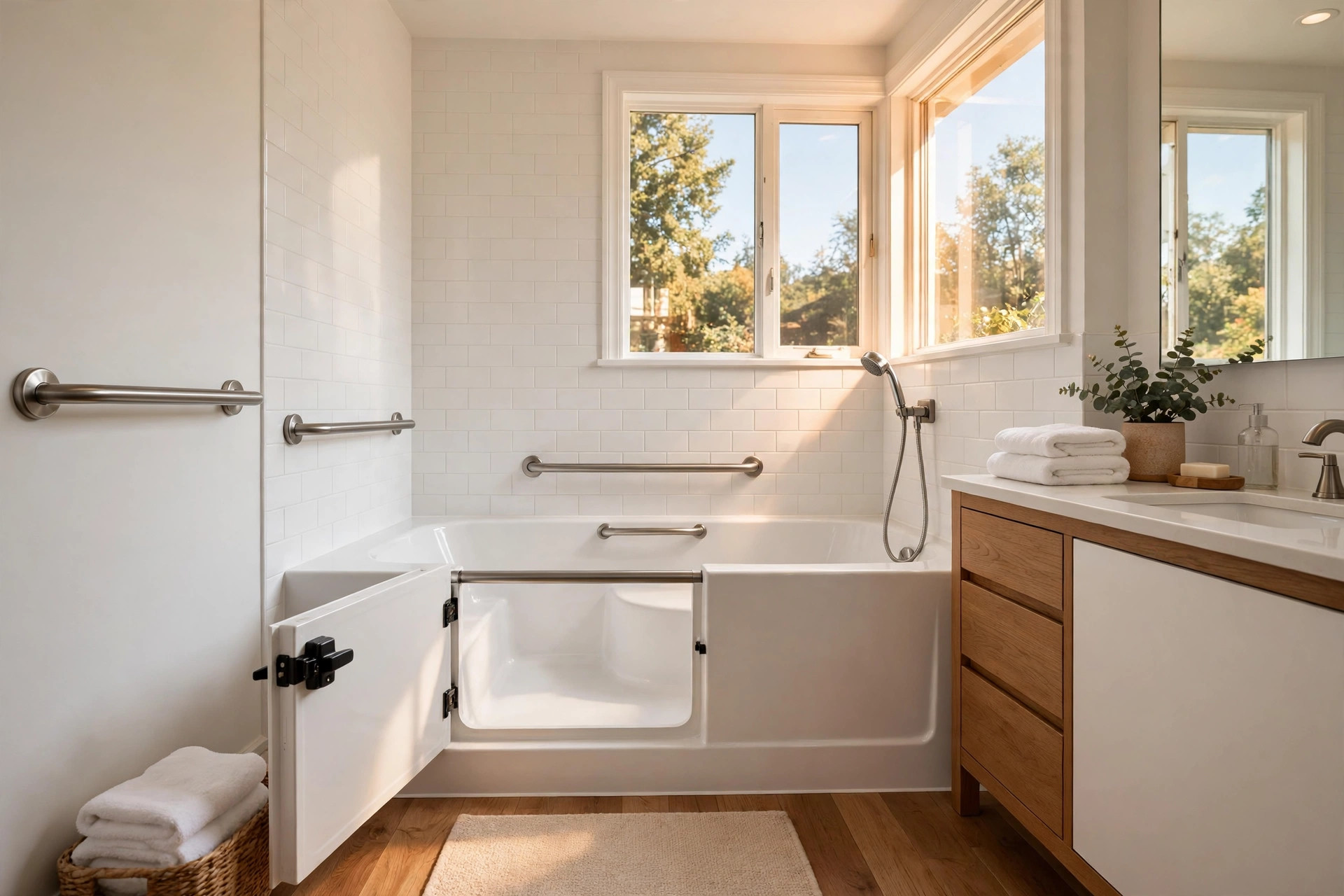
Walk-in tub with seat and grab bars
Walk-in tub with seat and grab barsHayes Bath Co.

Who a Walk-In Tub Actually Helps

Walk-in tubs are not for everyone, and they are not a gimmick for the people they suit. The households that get real value from one tend to share a few traits.

  • Soaking is the point. Some people shower for function and bathe for relief: sore joints, arthritis, a bad back, recovery after a long physical day. If a warm soak is genuinely part of how you manage pain or unwind, a walk-in tub protects that ritual instead of replacing it with a shower you tolerate.
  • Balance or mobility has changed. After a hip or knee replacement, with neuropathy, or with a condition that makes balance unreliable, the climb over a fourteen-inch tub wall, one wet foot in the air, is the riskiest move in the home. A three to five inch entry step, taken through a door, removes it.
  • A caregiver helps with bathing. A seated bather at a comfortable height, with controls in reach and room for a helper beside the tub, makes assisted bathing safer and more dignified for everyone involved.
  • The plan is to stay. Homeowners in Delaware, Westerville, and Marysville who intend to age in the houses they love often make this change before it is urgent, while the decision is calm and the install can be scheduled on their terms rather than after a fall.

If none of that sounds like your household, and the honest problem is just an ugly, worn-out tub, a standard replacement or a conversion will serve you better for less money. We would rather sell you the right project.

Safety Features That Matter

Walk-in tubs are sold with long feature lists, and some of them matter far more than others. These are the ones we would insist on for our own parents.

  • A genuinely low entry step. Three to five inches is the range that changes lives. Some models advertise walk-in access with a step closer to seven or eight inches, which for a compromised hip is barely an improvement. Check the number, not the brochure language.
  • A door that seals and swings the right way. The door must seal completely under water pressure, every time, for years. Inward-swinging doors are held tighter by the water itself and fit tight bathrooms; outward-swinging doors give wider entry but need clear floor space. Which suits your room is a measurement question we settle at the consultation.
  • A built-in seat at the right height. A seat around chair height lets you lower and raise yourself with your legs and the grab bars doing the work, rather than hauling up from the bottom of a tub.
  • Grab bars placed for entry and exit. Bars at the door, and within reach from the seat, anchored solidly. Bars are not accessories on a walk-in tub, they are half the reason it exists.
  • A fast drain. This is the feature first-time buyers forget. You sit in a walk-in tub while it fills, and you sit in it while it drains, because the door cannot open against the water. Dual drains or a powered drain that empties the tub in a couple of minutes instead of eight or ten is the difference between a comfortable routine and a chilly wait.
  • Anti-scald controls. A pressure-balanced, temperature-limited valve protects skin that may not sense heat as quickly as it once did.
The install

Measured first, installed in a day

Arrive and protectFloors covered, water off, room sealed.
Old unit outDemo contained, hauled away same morning.
New system setBase, panels, valve, and fixtures installed.
WalkthroughCleaned, checked, and walked with you.

Walk-In Showers vs Walk-In Tubs

This is the comparison we walk through at kitchen tables across Delaware County, so here it is in writing. A walk-in shower wins on entry: the lowest threshold of all, and the only option that works with a wheelchair or a shower chair rolled straight in. It is faster to use, easier to clean, uses less water, and costs less to install. For anyone whose mobility is declining progressively, the shower is usually the future-proof choice.

A walk-in tub wins on one thing, and it is a real thing: the soak. Hydrotherapy, pain relief, warmth, and the simple pleasure of a bath are things a shower cannot replicate. If the bather is mobile enough to step over a low threshold and lower onto a seat safely, and soaking is a genuine part of their health routine, the tub earns its price. The honest cautions are the fill and drain wait, the water use, and the fact that a person whose mobility declines further may eventually need the shower anyway.

Our recommendation, given in person with your bathroom in front of us, follows from those trade-offs. Plenty of households split the difference: a walk-in tub in one bathroom, an accessible shower in another. Call (740) 555-0100 and we will talk it through at your table, not from a script.

What Installation Involves

A walk-in tub install is more involved than a standard tub swap, and any company that waves that off is not being straight with you. The unit is larger and heavier, and it has to reach your bathroom through your house. Doorway widths, hall turns, and stair angles are measured at the consultation, because they decide which models can physically be installed in your home.

Your water heater matters just as much. A walk-in tub holds considerably more water than a standard tub, and a deep soak can call for fifty gallons or more of hot water. If your heater is a standard forty-gallon tank that already struggles, we will flag it before the sale, not after the first lukewarm bath, and a larger or supplemental heater can be planned into the project if you choose.

The install itself removes the old tub, sets and levels the walk-in unit, connects water, drain, and any electrical supply for pump or drain features, and fits the surrounding wall system. Most installs run one to two days depending on the unit and the room. Everything is quoted in writing at the consultation, scope, unit, heater considerations and all, before you commit.

Questions

Walk-In Tubs questions, answered straight

How much does a walk-in tub cost in Delaware, OH?+

Walk-in tubs run higher than our other projects because of the unit itself. Most installed walk-in tubs we quote land roughly in the $12,000–$22,000 range depending on the model, features like a fast drain or hydrotherapy jets, and what the room needs. Your exact figure comes from the free consultation as a written flat quote.

Do I have to sit in the tub while it fills and drains?+

Yes. The door seals against the water, so you enter, close the door, and fill; then drain before opening it to leave. That is why we consider a fast drain essential rather than optional, and why we talk honestly about whether the routine suits you before you buy.

Will a walk-in tub fit through my doors?+

Most homes in Delaware County can take one, but it is a measurement question, not an assumption. We measure doorways, halls, and turns at the consultation and match models to what fits your house. If a unit genuinely cannot get into the room, we will tell you there, not on install day.

Is a walk-in shower a better choice for me?+

It might be. If entry needs to be as low as possible, if a wheelchair or shower chair is involved, or if your mobility is likely to decline further, the shower is usually the better long-term answer, and it costs less. If soaking is central to your comfort and you can manage a low step safely, the tub makes sense. We will give you our honest read at the consultation, with prices for both.

The Hayes Bath Co. van, on a Delaware County street
The Hayes Bath Co. van, on a Delaware County streetHayes Bath Co.

Get your free design consultation

Tell us what you want changed and we will call back from (740) 555-0100 to set a time. The consultation is in your home, we bring finish samples, and you get a written flat quote. No pressure, no obligation.

Work Order / Free EstimateNo. HB-FORM

Tell us what you want changed. We call back with a time for your free in-home design consultation.


We call back from (740) 555-0100. That is the only number we have.

Call (740) 555-0100